Publication
How to start diving: experience
I dived for the first time in Egypt. I didn't really understand what was happening, why I was going underwater, and what the instructor was doing, pressing buttons on my vest.
Only a few months later, when I returned to Kyiv and decided to take a training course, did I realize that he was releasing air from my buoyancy control device (BCD) so that the weights on my weight belt would start pulling me down.
And although it was quite a long time ago, I clearly remember being absolutely thrilled when I saw a completely different world — corals, fish, and other marine life. It took my breath away to realize that one could breathe underwater. My breath being taken away by the ability to breathe — isn't it ironic?
Upon returning to Kyiv, I firmly decided to take a PADI training course, whose certificates are recognized worldwide.
Without a certificate, you won't be able to either rent equipment (even if you have your own gear, you won't fly to Cyprus or Egypt with scuba tanks, so you need to rent and fill them on-site) or get to a dive site. They are usually strict about this, and local dive centers check them.
To get your first, entry-level certificate, you need to complete the Open Water Diver course, which consists of three main parts.
1️⃣ Theoretical part to learn the basic principles of scuba diving.
It includes five sections of the textbook. At the end of each section, there is a knowledge review that you complete at home at your convenience.
This part involves reviewing the knowledge reviews with the instructor, discussing unclear material, watching video materials, taking quizzes, and passing the final exam.
2️⃣ Confined water dives (pool) to learn the basic skills of diving.
3️⃣ Open water dives to check your skills.
The Open Water Diver certificate allows you to dive in easy conditions and to a depth of up to 18 meters.
To dive deeper (the maximum for recreational diving is 40 meters), you need to take the Advanced Open Water Diver course. After that, you can obtain various specialties, such as first aid, deep diving, enriched air nitrox, cave diving, dry suit diving, etc.
I got my certificates (Open Water Diver and Advanced Open Water Diver), and off it went... There were countless safari trips. That's when you live on a yacht for a week, and all you do is dive, eat, and sleep.
A dream for any diver. There are even diving T-shirts with the humorous slogan "Dive. Eat. Sleep. Repeat".
So when I was invited to visit the museum in Ayia Napa, Cyprus, I didn't hesitate for a second. Besides having never dived in the Mediterranean Sea before, the prospect of seeing a purpose-built underwater museum was very inspiring.
Well, it was a great trip to Cyprus. Everything is very simple — just a 2-hour-and-40-minute flight and two days to prepare: take tests and fill out the Flight Pass.
Cyprus allows entry to either vaccinated people (Janssen/Johnson & Johnson, Vaxzevria Vaccine/AstraZeneca, Pfizer-BioNTech, Moderna Vaccine, Sputnik Vaccine, Sinopharm, Sinovac/CoronaVac), or you must take a test — one test two days before departure from Ukraine, and the second immediately upon arrival in Cyprus (which costs 15 EUR at Larnaca Airport).
I was lucky; I had been vaccinated with CoronaVac in advance and received a certificate from my family doctor. And although CoronaVac is not yet recognized in the EU, hospitable Cyprus accepts this vaccine.
Moreover, if you suddenly fall ill with COVID-19 in this wonderful place, you will be placed in quarantine and treated free of charge by the Cypriot government.
Also, in any case, you need to fill out the Cyprus Flight Pass on the website, specifying your details, whether you are vaccinated or tested, and upload the certificate or test result. This must be done two days before departure.
We arrive in Larnaca, which welcomes us with bright sunshine and pleasant heat. The drive to the MUSAN underwater museum in Ayia Napa takes about an hour.
The museum itself is located at a depth of 10 meters and 200 meters from the shore. Diving in the museum is free (no ticket required), but you will have to pay for the dive center services (dive guide, tank and weight rental). In addition, if you need diving gear, you can also rent it at the dive center.
Underwater, a magnificent view of the sculptures on the seabed opens up, which were designed by underwater sculptor Jason Decaires Taylor. But it's impossible to describe them, it's better to look at the photo.
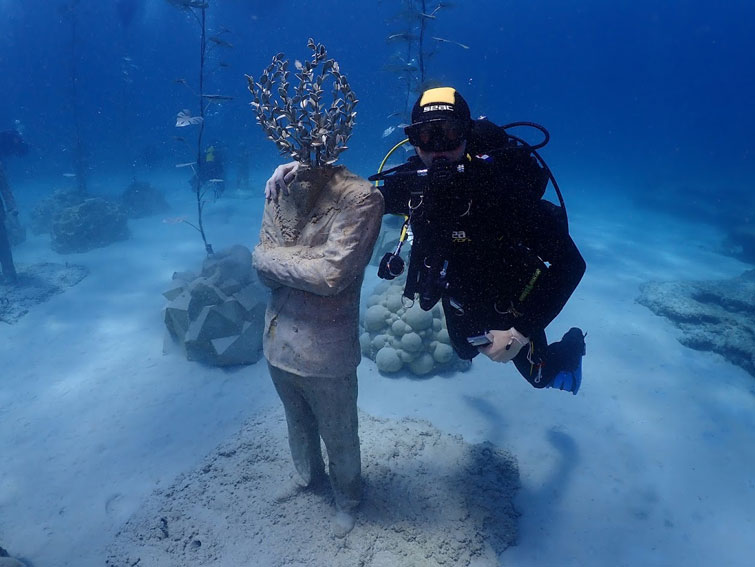
Photo: Olena Verheychyk
In addition to the museum, there are other dive sites in Cyprus — shipwrecks: MS Zenobia, Constandis, Lady Thetis; reefs and caves: St George – Geronisos, Manijin Island, etc.
Reference:
MS Zenobia
Maximum depth 42 meters, visibility 25 meters.
Zenobia is 172 m long and 28 m wide.
The richest marine life in Cyprus: corals, barracudas, groupers, nudibranchs, moray eels, turtles.
This can be one of the most enjoyable, but also one of the most challenging dives due to depth and occasional currents.
One of the best shipwreck dive sites in the world. Several dives are needed to explore all aspects and beauty of the wreck. If you go diving in Cyprus, this is the one place not to be missed.
Lady Thetis
Maximum depth 19 meters, visibility 20 meters.
Lady Thetis is one of two ships sunk to promote diving in the area.
The vessel was a passenger ship and was sunk in February 2014.
Rich, diverse marine flora and fauna: groupers, nudibranchs, moray eels.
It is located 200 meters from Constandis, another good dive site.
Manijin Island
Maximum depth 18 meters, visibility 20 meters.
Mostly flat sandy bottom with rocky patches.
Flora and fauna: moray eels, octopuses.
At the end of this site, there is a huge blowhole! Initially, it was an air bubble in the rock, but later the roof collapsed, creating a bowl. Expect to see caves and arches covered in pink and purple coralline algae!
St George – Geronisos
Maximum depth 12-35 meters, visibility 20 meters.
Most suitable for beginners. Mostly flat sandy bottom with rocky patches.
Three wonderful ridges (12m, 18m, and 35m) covered with pink and purple algae.
And in between dives, you can walk along the beautiful streets of Cypriot cities — Ayia Napa, Limassol, Paphos, etc., and also taste delicacies in a tavern. I advise you to try fish or meat meze — which translates as a snack, but is essentially a set of a large number of dishes brought one by one.